Research overview
Separation and materials processes using supercritical carbon dioxide
The High-Pressure Fluid Properties Laboratory (Ushiki Lab) is part of the Chemical Engineering Program, Graduate School of Advanced Science and Engineering, Hiroshima University, Japan. The laboratory is led by Associate Professor Ikuo Ushiki.
Carbon dioxide (CO2) in its supercritical state, that is, above its critical temperature (about 31 °C) and critical pressure (about 7.4 MPa), has outstanding features compared with conventional organic solvents, such as high diffusivity, low interfacial tension, and no need for solvent drying, and it is expected to be applied to a wide range of processes. Our laboratory develops new separation processes and high-performance materials by making combined use of the unique features of supercritical CO2 and the distinctive nanospaces of porous materials, based on the related equilibrium and transport properties.
Keywords: supercritical fluids, carbon dioxide (CO2), CCUS, phase equilibria, equilibrium and transport properties, chemical engineering thermodynamics, equations of state, porous materials, polymers
What is a supercritical fluid?
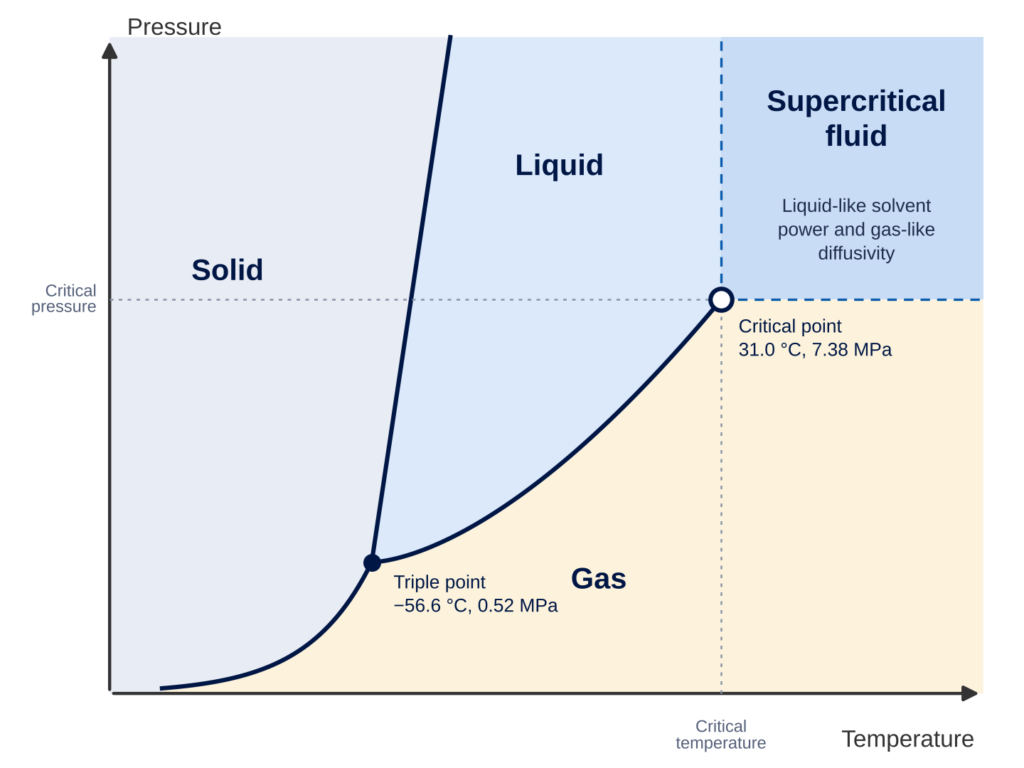
When a substance is held at a temperature and pressure above its critical point (critical temperature and critical pressure), it becomes a supercritical fluid, in which there is no distinction between liquid and gas. A supercritical fluid combines the solvent power of a liquid with the diffusivity of a gas, and its density and solvent power can be changed greatly by temperature and pressure.
Carbon dioxide and water, which are available in large quantities, are the most widely used. Supercritical CO2 in particular has the following features:
- It can be used under relatively mild conditions (critical temperature of about 31 °C).
- It has a low environmental impact, is safe, and saves energy (no solvent drying is needed).
- Its solvent properties can be controlled by temperature and pressure.
- It penetrates and diffuses easily into fine pores.
Industrial applications of supercritical CO2 include drying of porous materials such as aerogels and catalysts, cleaning of precision parts, dry cleaning, regeneration of adsorbents, decaffeination, extraction of flavors and pharmaceutical ingredients, supercritical fluid chromatography, removal of solvents and monomers from polymers, impregnation of metals and drugs into porous materials, dyeing of fibers, and production of microcellular plastics and fine particles. A more detailed explanation (in Japanese) is available on our page 超臨界流体とは (What is a supercritical fluid?).
Research topics
1. Novel porous materials prepared with supercritical CO2 (CO2 capture including DAC, drug delivery systems)
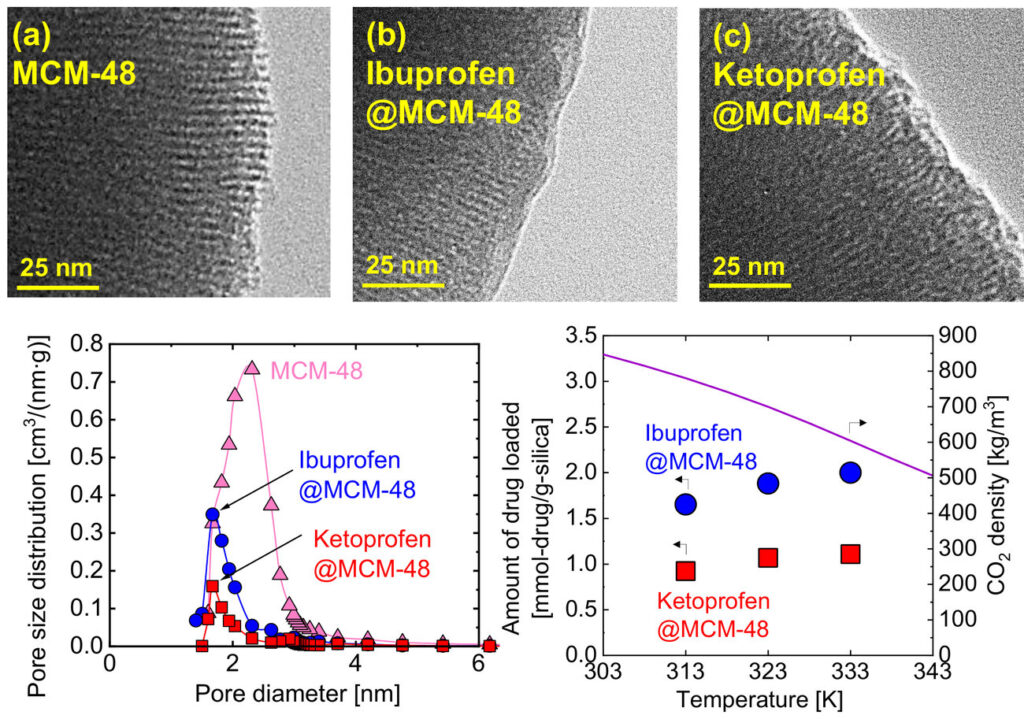
Taking advantage of the high penetrability and diffusivity of supercritical CO2, we develop materials processes (supercritical fluid methods) in which functional substances are impregnated into and loaded onto the nanopores of porous materials such as metal–organic frameworks (MOFs) and mesoporous silica.
For example, we prepare ionic-liquid-impregnated nanoporous materials, in which ionic liquids with a high CO2 absorption capacity are loaded into the pores of MOFs, aiming at direct air capture (DAC) of CO2 from the atmosphere. We also work on amine-impregnated CO2 sorbents, drug carriers for drug delivery systems in which drugs such as ibuprofen and ketoprofen are loaded onto mesoporous silica (MCM-48 and SBA-15), and the preparation of mesoporous silica by template extraction with supercritical CO2.
Selected publications
- Carrier-dependent pressure of maximum loading in supercritical CO2 drug impregnation: Ibuprofen and ketoprofen in MCM-48 with a three-dimensional pore network
Yuto Asai, Ikuo Ushiki*, J. CO2 Util., 113, 103613 (2026). - Evaluation of drug loading onto MCM-48 via supercritical CO2 deposition: Effects of drug type, temperature, and silica structure
Yuto Asai, Ikuo Ushiki*, J. Supercrit. Fluids, 229, 106824 (2026). - Impregnation of non-steroidal anti-inflammatory drugs (ibuprofen and ketoprofen) onto mesoporous silica SBA-15 using supercritical CO2
Kairi Yamamoto, Ikuo Ushiki*, J. CO2 Util., 92, 103022 (2025). - Preparation of Mesoporous Silica Materials MCM-41 and SBA-15 Using a Template Extraction Method with Supercritical CO2
Ikuo Ushiki*, Haruna Oka, Mizuki Hironaka, Hiromu Tsuji, Kagaku Kogaku Ronbunshu, 51(3), 58–63 (2025).
2. Adsorption and desorption processes in supercritical fluids
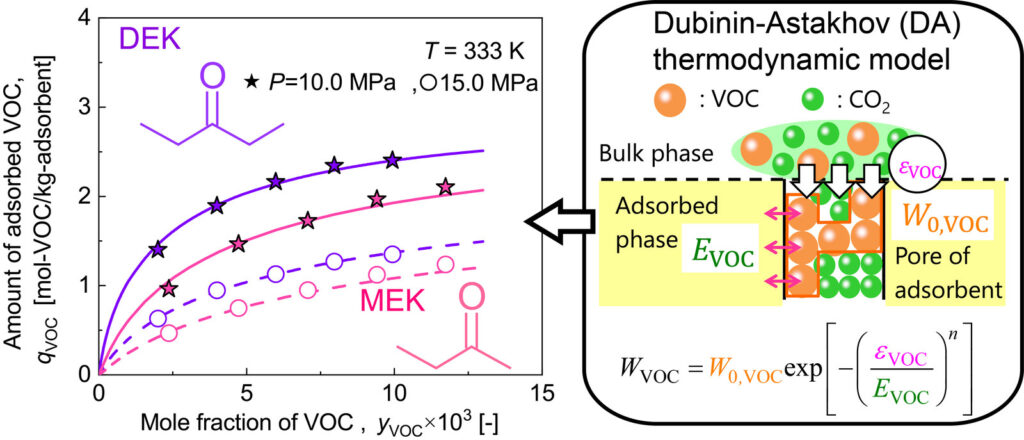
We study regeneration processes for high-performance adsorbents, in which adsorbed volatile organic compounds (VOCs) are desorbed with supercritical CO2, and we are also working toward practical application through joint research with industry.
To design such processes strategically, we measure the adsorption–desorption equilibria and behavior of VOCs on activated carbon, mesoporous silica (MSU-H), and MOFs in supercritical CO2, and model them with thermodynamic models based on the potential theory (Dubinin–Astakhov equation).
Selected publications
- Thermodynamic Analysis of 2-Pentanone Adsorption on Activated Carbon under Supercritical CO2 Conditions at P = (10.0 to 20.0) MPa and T = (313 to 353) K
Daichi Imai, Ikuo Ushiki*, J. Chem. Eng. Data, 71, 882–891 (2026). - 1-butanol adsorption on activated carbon in supercritical CO2: Experimental measurements and thermodynamic modeling
Daichi Imai, Ikuo Ushiki*, J. Supercrit. Fluids, 229, 106802 (2026). - Enhanced Adsorption of Polar VOCs on MSU-H Mesoporous Silica under Supercritical CO2 Conditions
Ikuo Ushiki*, Mizuki Hironaka, Ind. Eng. Chem. Res., 64, 25007–25016 (2025). - Adsorption Equilibria of n-Hexane on Metal–Organic Frameworks in Supercritical CO2: Measurement and Thermodynamic Modeling with a Potential Theory
Ikuo Ushiki*, Mizuki Hironaka, Yuji Ueno, Ind. Eng. Chem. Res., 64, 12228–12238 (2025).
3. Modeling of bulk and nanospace properties for supercritical impregnation processes
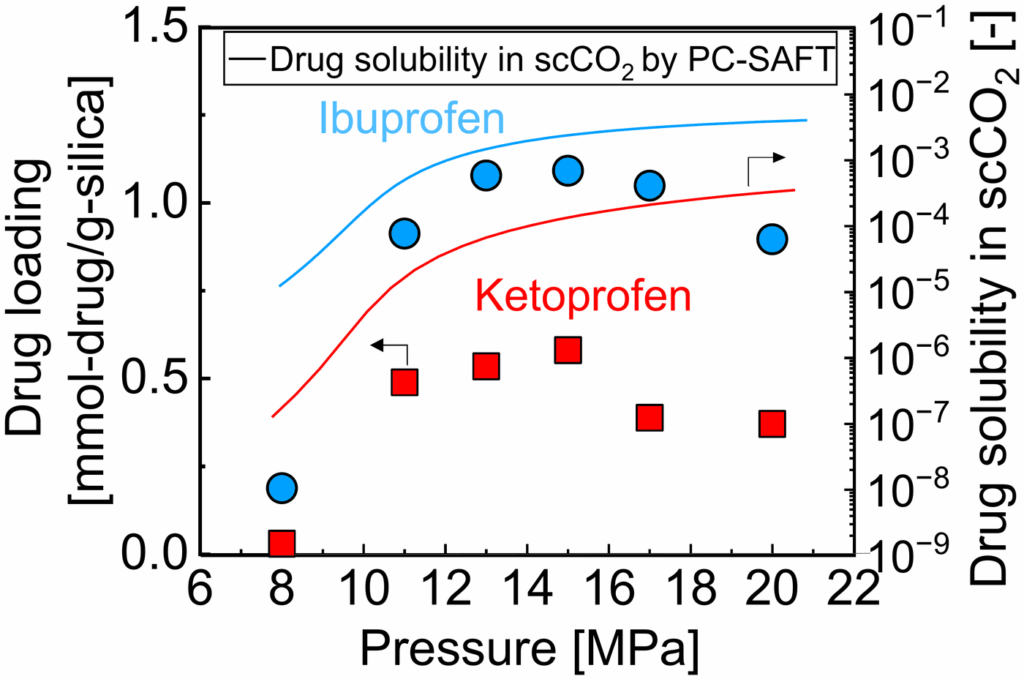
To design supercritical impregnation processes rationally, it is necessary to understand both the solubility of solutes in the supercritical CO2 phase (bulk phase) and their adsorption and loading behavior in the nanopores of porous materials (nanospace).
We measure the solubilities of drugs, organometallic complexes (metal precursors), ionic liquids, and other solutes in supercritical CO2, as well as their adsorption behavior in nanopores. We model these data with equations of state such as PC-SAFT, the Sanchez–Lacombe equation, and the Peng–Robinson equation, and quantitatively analyze how operating conditions such as temperature and pressure affect the amount loaded.
Selected publications
- Unveiling the Critical Role of Pressure in Supercritical CO2-Assisted Drug Impregnation into SBA-15 Mesoporous Silica
Keigo Kamichoja, Ikuo Ushiki*, J. Chem. Eng. Jpn., 59(1), 2604404 (2026). - Modeling of ionic liquid solubility in supercritical carbon dioxide + co-solvent phase predicted by ε*-modified Sanchez-Lacombe equation of state
Yuya Hiraga*, Ikuo Ushiki*, Fluid Phase Equilib., 595, 114417 (2025). - Modeling cobalt (III) acetylacetonate and iron (III) acetylacetonate solubilities in supercritical CO2 with PC-SAFT based on experimentally-determined solid–liquid equilibria in organic solvents
Ikuo Ushiki*, Azusa Miyajima, Ryo Fujimitsu, Shigeki Takishima, J. Supercrit. Fluids, 196, 105882 (2023).
4. Measurement and modeling of high-pressure phase equilibria of supercritical fluid + polymer systems
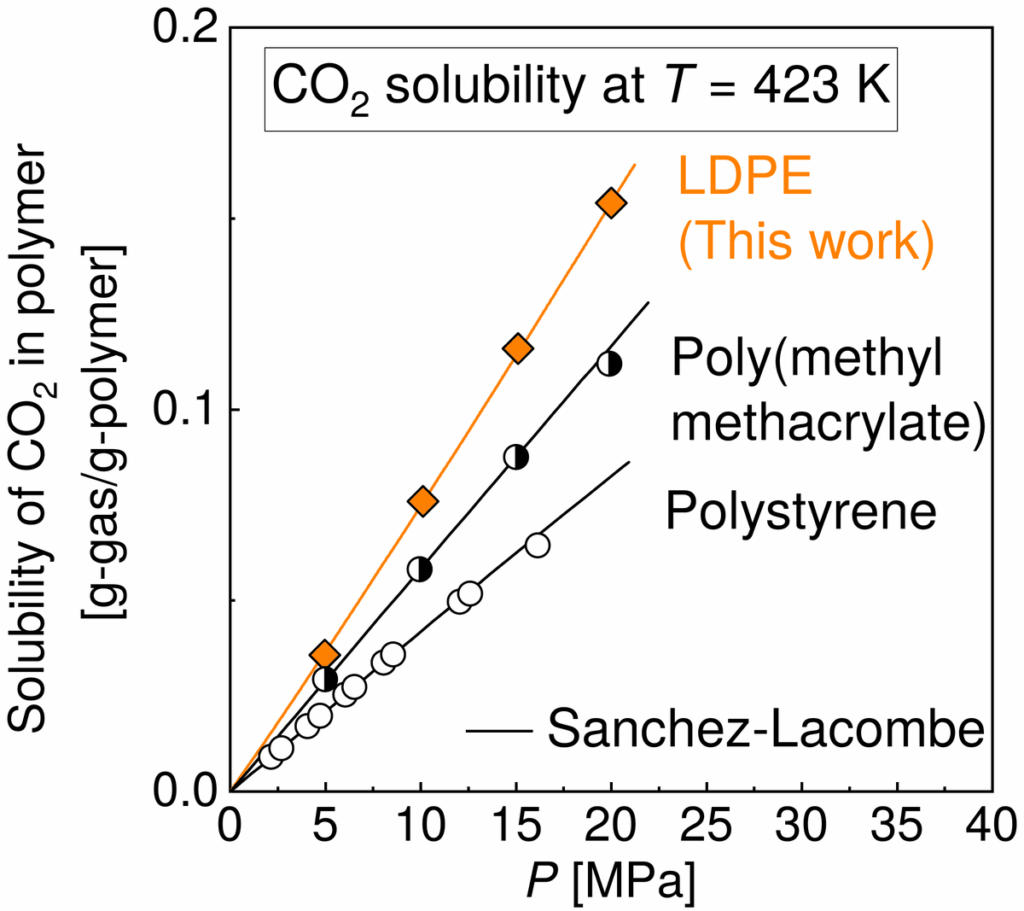
We measure the high-pressure phase equilibria and transport properties of supercritical fluid + polymer systems at high temperatures and pressures, such as gas solubilities, diffusion coefficients, and phase separation pressures, which are needed to design manufacturing and processing of polymer materials (polymerization, removal of solvents and monomers, foaming, and so on). The data are modeled with equations of state such as PC-SAFT and the Sanchez–Lacombe equation combined with free volume theory.
Recently, we have been measuring and modeling the phase behavior of polyolefin + monomer gas + solvent systems at high temperatures and pressures for production processes of high-performance polyolefins.
Selected publications
- CO2 solubilities in low-density polyethylene (LDPE) in its molten state over high temperatures and pressures conditions
Rizqy Romadhona Ginting, Ikuo Ushiki*, Kanako Otsubo, J. CO2 Util., 99, 103164 (2025). - CO2 solubility and diffusivity in poly(vinyl acetate) studied using the PC-SAFT and free volume theory
Ikuo Ushiki*, Saki Ota, Shin-ichi Kihara, Shigeki Takishima*, J. Supercrit. Fluids, 194, 105836 (2023). - Solubility and diffusivity of supercritical CO2 for polycaprolactone in its molten state: Measurement and modeling using PC-SAFT and free volume theory
Ikuo Ushiki*, Hirotaka Kawashima, Shin-ichi Kihara, Shigeki Takishima*, J. Supercrit. Fluids, 181, 105499 (2022).
For all of our papers, see the publication list.
Contribution to science and society
A sustainable society requires technologies that make effective use of the CO2 emitted in large quantities by human activities. The supercritical CO2 processes studied in our laboratory also provide a powerful approach to utilizing CO2 from the perspective of CCUS (carbon capture, utilization, and storage).
Through this research, students acquire knowledge and skills that are highly important in thermodynamics, high-pressure fluid properties, materials processing, and the chemical industry.
Laboratory life
- We respect the independence and initiative of students and intentionally do not set core hours (a short morning meeting is held every day at 10:20).
- We guide and support students so that they can submit a paper to a peer-reviewed international journal as the first author by the time they complete the master’s program (six papers with student first authors in 2025–2026).
- Graduate students carry out research together with junior students to develop their mentoring skills.
- We actively promote joint research with companies, and graduate students are expected to present their results at academic conferences.
- Weekly progress meetings are held every Monday, and a seminar (progress reports, journal club, etc.) is held once a week.
Career paths
Our master’s graduates (fiscal years 2017–2025) have joined the following companies and organizations:
AGC, Asahi Kasei, Central Glass, Dainichiseika Color & Chemicals, ENEOS, Hitachi Plant Services, Idemitsu Kosan, Japan Sewage Works Agency, JGC Corporation, Kanro, KIRIN, Kobelco Eco-Solutions, Kuraray, LINTEC, Mitsubishi Chemical, Mitsui Chemicals, MITSUI E&S, NIPPON STEEL Chemical & Material, Nissan Chemical, Otsuka Pharmaceutical, RENIAS, SEKISUI CHEMICAL, SUMCO, Sumitomo Bakelite, Sumitomo Metal Mining, Tokuyama, Toray Industries, TOTO, TOYOBO
Contact and access
Prospective students and researchers interested in our research, as well as companies interested in joint research, are welcome to contact us by e-mail.
Associate Professor Ikuo Ushiki
E-mail: iushiki at hiroshima-u.ac.jp
High-Pressure Fluid Properties Laboratory, Chemical Engineering Program, Graduate School of Advanced Science and Engineering, Hiroshima University
Room 334, Building A4, Faculty of Engineering
1-4-1 Kagamiyama, Higashi-Hiroshima, Hiroshima 739-8527, Japan
Access: Higashi-Hiroshima Campus (Hiroshima University website)
Researcher profiles of Ikuo Ushiki: researchmap / ORCID / Hiroshima University Researcher Directory / Hiroshima University Research Seeds
Reference
- R. Span, W. Wagner, “A New Equation of State for Carbon Dioxide Covering the Fluid Region from the Triple-Point Temperature to 1100 K at Pressures up to 800 MPa,” J. Phys. Chem. Ref. Data, 25, 1509–1596 (1996). https://doi.org/10.1063/1.555991